In Dallas County, owning a home almost always comes with owning a car
Only 2.4% of owner households lack a vehicle, a gap of 8.8 percentage points with renters.
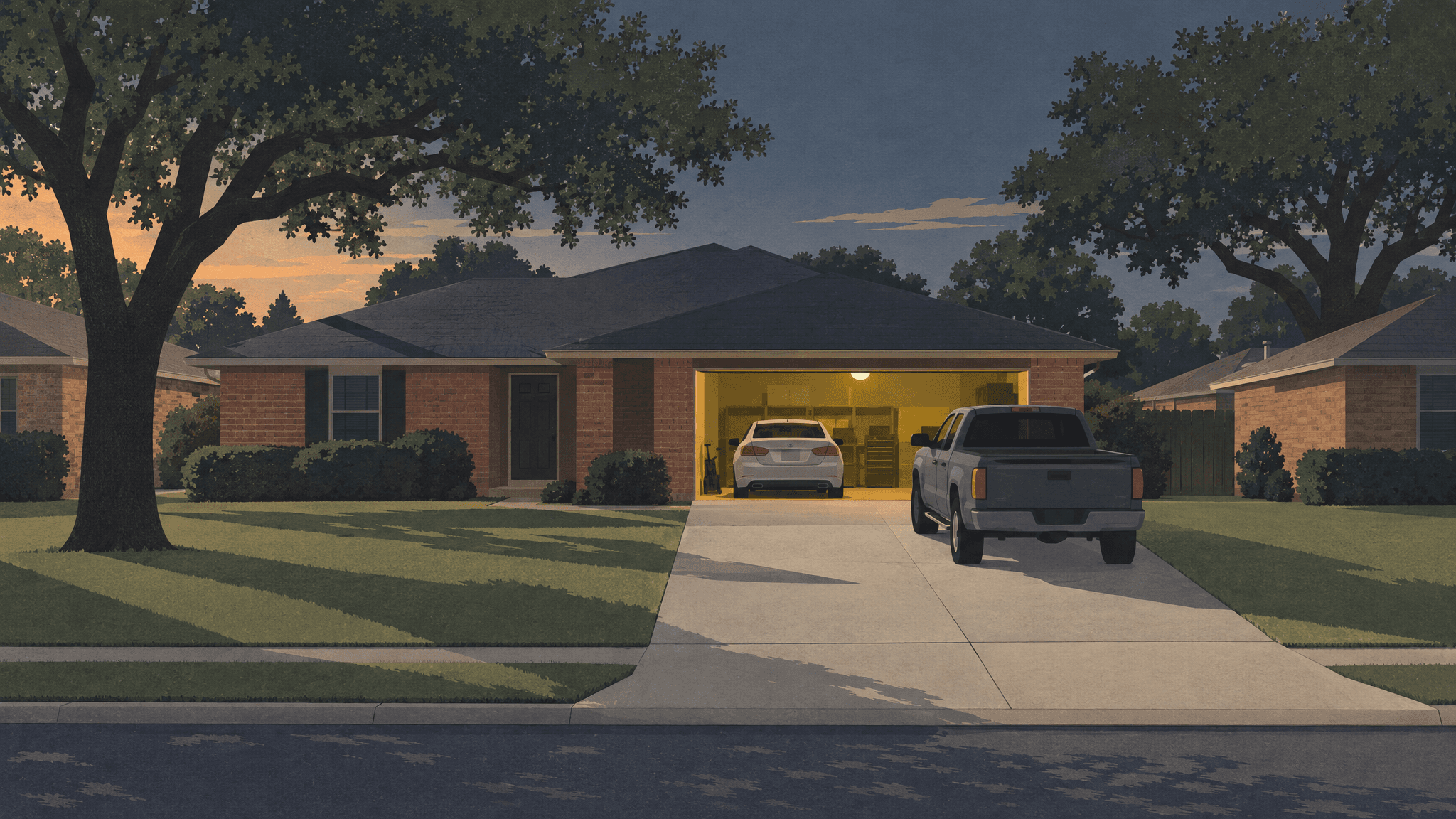
Going without a car in Dallas County is mostly a renter's arrangement.
Of the 66,428 county households with no vehicle available, 81.7% rent their homes, according to Census Bureau estimates from the American Community Survey covering 2020 through 2024. For those households, getting to work, school or the grocery store runs on something other than a household car.
Across the county, 6.8% of households have no vehicle. That is higher than the Texas share of 5.4%. It is also 1.6 percentage points below the national rate of 8.4%.
In a state built around the pickup truck and the toll road, Dallas County is less tied to the car than Texas as a whole. It is still more tied to it than the country.
Renters carry the load
The split between renters and owners is wide. Among Dallas County renters, 11.2% have no vehicle. Among homeowners, the share is 2.4%.
The gap between them is 8.8 percentage points. Statewide, 10.8% of renters and 2.2% of owners have no vehicle.
Nationally, the shares run higher for both groups: 17.9% of renters and 3.2% of owners.
The household budget is part of the picture. An unlimited DART pass costs a fraction of what it takes to own and operate a vehicle in Dallas (The Texas Observer). Across Dallas-Fort Worth, the average household spends nearly as much on transportation each month as it does on housing (The Texas Observer).
Texas neighbors, Sun Belt peers
Next to the state's other big urban counties, Dallas County lands in the same range. Harris County, home to Houston, comes in at 7.1%. Bexar County, home to San Antonio, comes in at 6.4%. Each difference from Dallas County is within the margin of error.
Outside Texas, the differences hold up. In Fulton County, Georgia, the core of metro Atlanta, 10% of households have no vehicle. In Miami-Dade County, Florida, the share is 9.8%. Maricopa County, Arizona, which takes in Phoenix and its car-oriented suburbs, comes in lower, at 5.1%.
A transit-dependent core
The countywide share blends very different places. Research reported by The Texas Observer found that areas in Dallas-Fort Worth with high concentrations of low-income people, minorities and zero-car households form a transit-dependent core (The Texas Observer). By far the largest such area in Hamidi's study was southern Dallas, a broad swath reaching from I-30 south of downtown all the way to the city limits (The Texas Observer).
Living there without a car means leaning on a system with gaps. A large share of the city's transit-dependent residents did not live within the usual walking distance of a bus stop or rail station, Hamidi found (The Texas Observer). People in those areas could reach only a small share of jobs on a reasonable DART commute (The Texas Observer).
Riders often face multiple transfers, and service is infrequent at midday and late at night (The Texas Observer). The agency mostly built its rail routes along old freight lines that were convenient to buy but not strategically located, the Observer reported (The Texas Observer).
Meanwhile, new jobs and services have clustered in the northern and southern suburbs, and those suburbs are hard to reach from Dallas without a car (The Texas Observer).
About the data
We used American Community Survey estimates for 2020–2024 on vehicles available by tenure for Dallas County, Texas, the U.S. and the principal counties of peer metros: Harris, Bexar, Fulton, Maricopa and Miami-Dade. We compared shares using the published margins of error and describe a difference as real only when it is statistically significant.
- These are survey estimates pooled across 2020 through 2024, so they describe a multiyear period rather than a single year.
- The data counts households with no vehicle but cannot say whether they go without by choice, by cost or for some other reason.
- County-level shares can hide big differences between neighborhoods, such as those between southern Dallas and the rest of the county.
No vehicle available: the Census Bureau's count of households with no cars, vans or trucks kept at home for household use. Percentage point: the simple difference between percentages, such as the gap between the renter and owner shares. Principal county: the county that contains the main city of a metro area, such as Fulton County for Atlanta.
Sources
- U.S. Census Bureau, American Community Survey: Tenure by Vehicles Available (ACS 5-year 2020–2024), latest period 2024; retrieved Oct. 19, 2026. Data
More from Transportation
The Dallas Standard in your inbox
The week’s North Texas news, every Sunday. Free.
0 Comments
Sign in with a free account to join the conversation.
Loading comments…